On-Page SEO
On-Page SEO Services in London
“Content is king” — you’ve probably heard it a hundred times, and it’s still one of the few SEO principles that’s survived every major Google algorithm update.
But even the best content won’t rank if your website isn’t set up correctly for search engines to read and understand it. That’s exactly what on-page SEO fixes.
What Is On-Page SEO?
On-page SEO (also called on-site SEO) is the practice of optimising the visible and technical elements of your individual web pages — things like your titles, headings, content, and internal links — so search engines can properly understand what each page is about and rank it accordingly.
Done right, it helps your website show up for the exact searches your London customers are already using to find businesses like yours.
Our On-Page SEO Services
- SEO Audits — a full review of your website to identify what’s holding your rankings back
- Keyword Research — finding the exact search terms your London customers are using to find businesses like yours
- Search-Focused Copywriting — content written naturally for real readers, while still targeting the keywords that matter for rankings
- Site Architecture Strategy — structuring your website so both visitors and search engines can navigate it easily
- Monthly Optimisation & Reviews — ongoing checks and improvements to keep your rankings moving in the right direction
Why Is On-Page SEO Important?
Think of on-page SEO as your website’s introduction to Google. It needs to clearly communicate what your business does, who you serve, and what value you offer — so Google can rank you accurately for the searches that matter to your customers.
On-page SEO is one of the three core pillars of SEO, working alongside technical SEO and off-page SEO. Together, these help your pages rank higher in search results — though in practice, they often overlap rather than staying in neat, separate boxes.
It’s called “on-page” because the changes are visible directly on your website — unlike off-page SEO, which happens elsewhere (like backlinks from other sites).
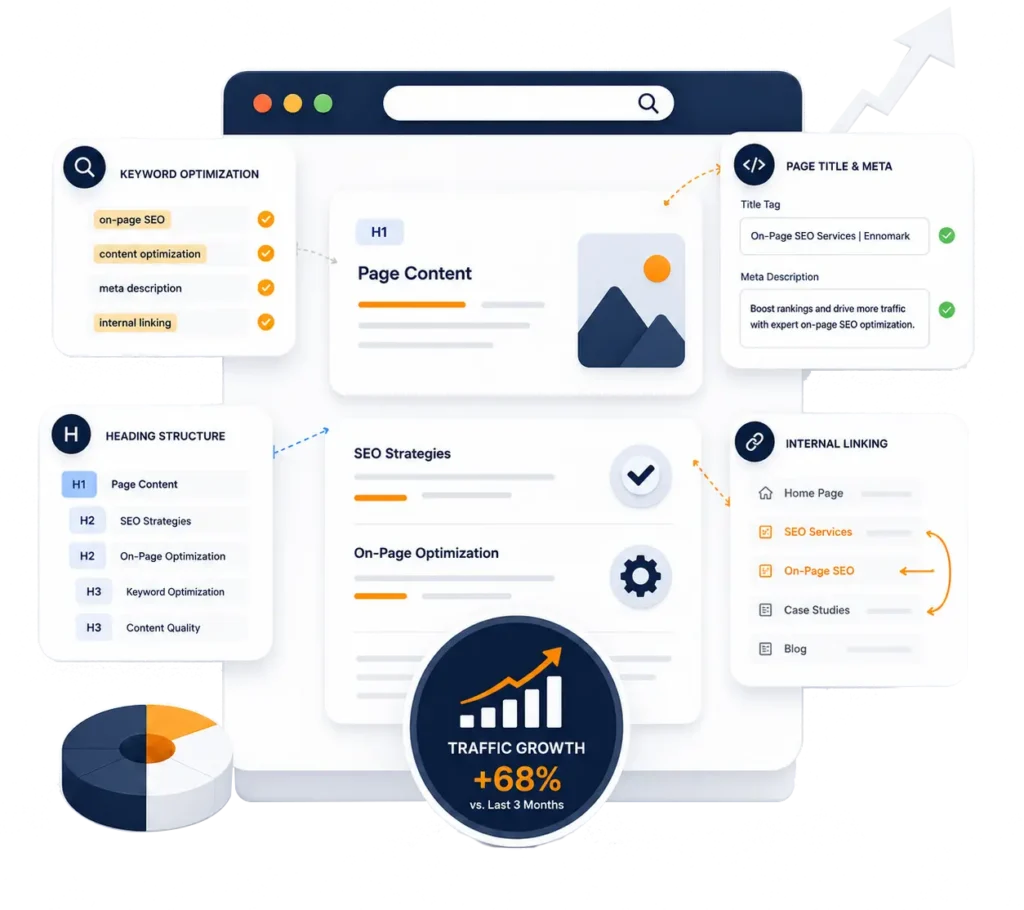
When Google crawls your website, it looks at more than just your written content. On-page SEO also covers things like header tags, image alt text, site structure, HTML elements, and metadata — all the technical details that help search engines understand exactly what each page is about.
For London businesses competing in a crowded market, getting these fundamentals right often makes the difference between showing up on page one or getting lost further down the results.
Our On-Page SEO Approach
We break on-page SEO down into three core principles:
1. Content Elements
Content elements are everything within your website’s actual text and copy. The goal here is always high-quality, genuinely useful content — not just words written to hit a keyword count.
We start every project with keyword research, so your content matches exactly what your London customers are searching for and actually intending to find. Our approach includes:
- Writing for real buyer personas, not generic audiences
- Naturally incorporating keywords and long-tail search terms — never forced or stuffed
- Using engaging visuals that support the content, not just fill space
- Adding clear calls-to-action that guide visitors toward getting in touch
- Directly answering the questions and problems your customers are searching for
2. HTML Elements
HTML elements refer to the parts of your page’s source code — things like page titles, headings (H1, H2, H3), meta descriptions, and image alt text. While this technically falls under technical SEO, it overlaps heavily with on-page SEO because getting these elements right directly improves the experience for anyone visiting your site.
We make sure every page has properly structured titles and headings, descriptive meta tags, and alt text that both search engines and visitors can understand — small details that add up to a real ranking difference.
3. Site Architecture
Site architecture is how your website and its pages are structured and connected to each other. A clear, logical structure makes it easier for search engines to crawl your site and understand how your pages relate to one another — which helps your content get properly indexed and ranked.
This includes optimising your page URLs, layout, and internal linking, so both visitors and search engines can move through your website smoothly and find what they’re looking for.
For London businesses with multiple service pages, a well-planned site structure also helps customers find exactly the service they need — without getting lost.
Get Started With Ennomark
As we’ve covered, on-page SEO is just one part of a complete SEO strategy. At Ennomark, we take a holistic approach — making sure on-page, off-page, and technical SEO all work together seamlessly, rather than treating them as separate, disconnected tasks.
If you’re ready to get your website working harder for your London business, get in touch and let’s get started.
Our SEO Services
We provide complete SEO solutions designed to improve rankings, visibility, website performance, and qualified traffic across search engines, AI platforms, and local results.
FAQ's
Common Questions About On-Page SEO
On-page SEO is the process of optimising individual web pages — content, titles, headings, and structure — so search engines can understand them and rank them higher for relevant searches.
On-page SEO covers everything you control directly on your website, like content and page structure. Off-page SEO covers external factors, like backlinks and brand mentions, that build your site's authority elsewhere online.
The key factors include title tags, meta descriptions, header tags (H1-H3), keyword usage, internal linking, image alt text, URL structure, and overall content quality.
Most websites start seeing improvements within 4-8 weeks of on-page changes, though full results often build over 3-6 months as search engines re-crawl and re-index your pages.
No — on-page SEO is essential, but it works alongside technical SEO and off-page SEO. A well-optimised page still needs backlinks and a technically sound website to rank competitively.
Start with keyword research, then optimise your title tags, headings, and content around those terms, add internal links, compress images, and make sure your content genuinely answers what your audience is searching for.
Basic on-page SEO (titles, headings, content) can be done yourself with the right guidance. But for larger sites or competitive industries, a professional approach saves time and avoids costly mistakes.
It's best practice to review and refresh key pages every 3-6 months, especially as search trends, competitors, and your own business offerings change.